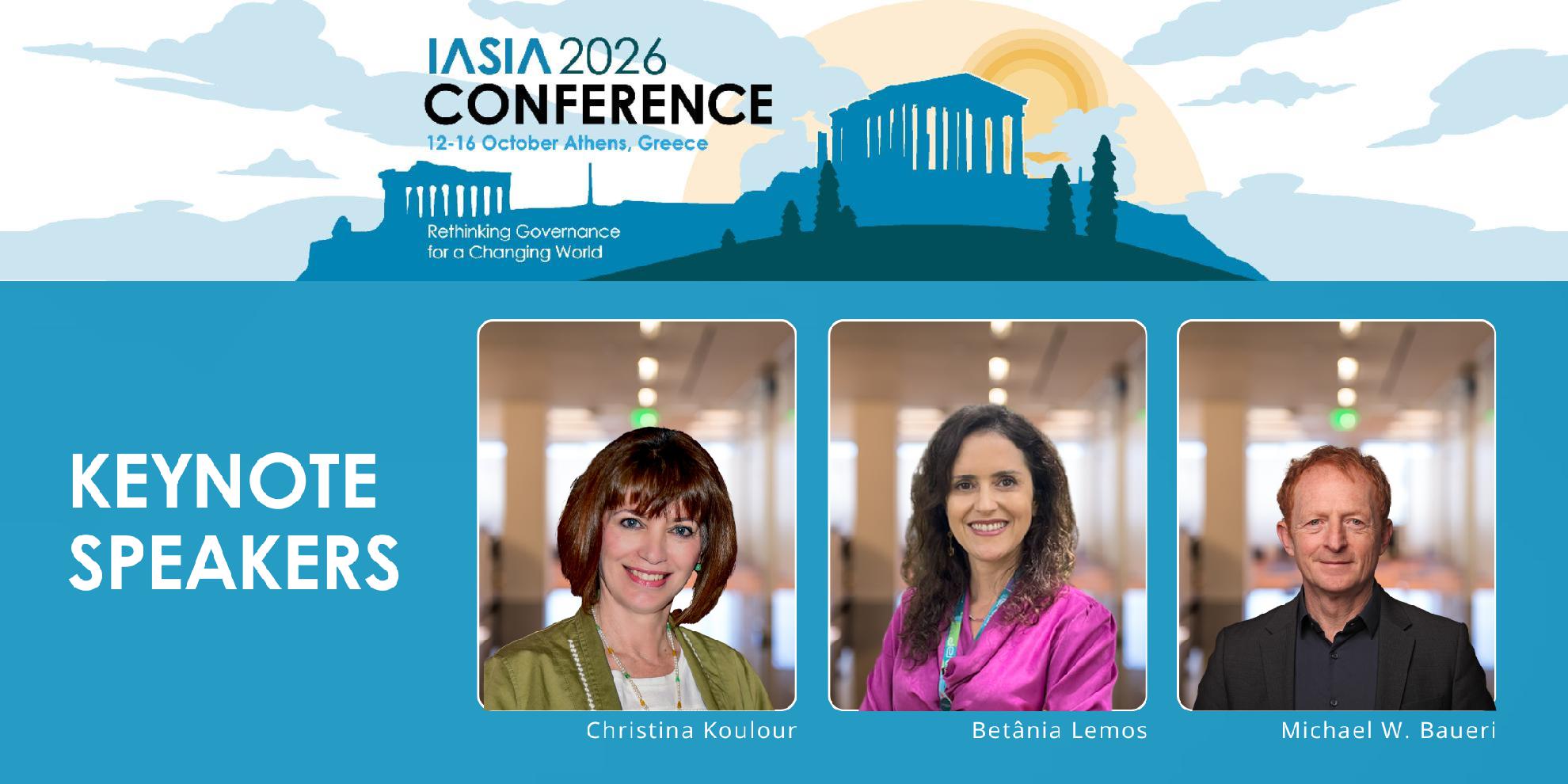
We are pleased to announce Betânia Lemos, Michael W. Bauer and Christina Koulouri as keynote speakers for the IASIA 2026 Annual Conference, taking place in Athens from 12 to 16 October 2026 under the theme “Rethinking Governance for a Changing World.”
The three speakers bring distinct academic and professional backgrounds to the conference, spanning public administration and institutional leadership, European and international governance, and modern and contemporary history.
Betânia Lemos, President of Brazil’s National School of Public Administration (Enap), brings more than 15 years of experience as a federal civil servant, including work on the economic evaluation of social projects and public policies, institutional innovation, change implementation and educational management. An economist and specialist in new technologies for education, she was included in Apolitical’s 2024 list of 50 public servants working with governments to advance gender equality policies.
At the European University Institute, Michael W. Bauer holds the Chair of Public Administration at the Florence School of Transnational Governance. His research focuses on European and international public administration, multilevel governance and the role of bureaucracy in democratic systems. He is also the principal investigator of the ERC Advanced Grant LIBRAD, examining liberal administration under populist rule.
Bringing a different disciplinary background, Christina Koulouri is Professor of Modern and Contemporary History and Rector of Panteion University of Social and Political Sciences in Athens. Educated in Athens and Paris, she has held research positions at Paris I-Panthéon-Sorbonne, Princeton University and the University of Regensburg. The author of eight books and more than 50 articles, she has received national and international awards for her research and publications.
Their experience and insights will offer conference participants valuable perspectives on the challenges and transformations shaping public administration today. We look forward to welcoming you to Athens this October.
Register now and join us at #IASIA2026.

 IASIA Conference Website -
Link